Door-side glance
Velo shows time, weather, and reminder context where the user naturally checks before leaving.
Product surface
Velo turns weather, time, reminder state, hook LEDs, and OTA reliability into one quiet daily object: glance once, take what matters, and leave with confidence.
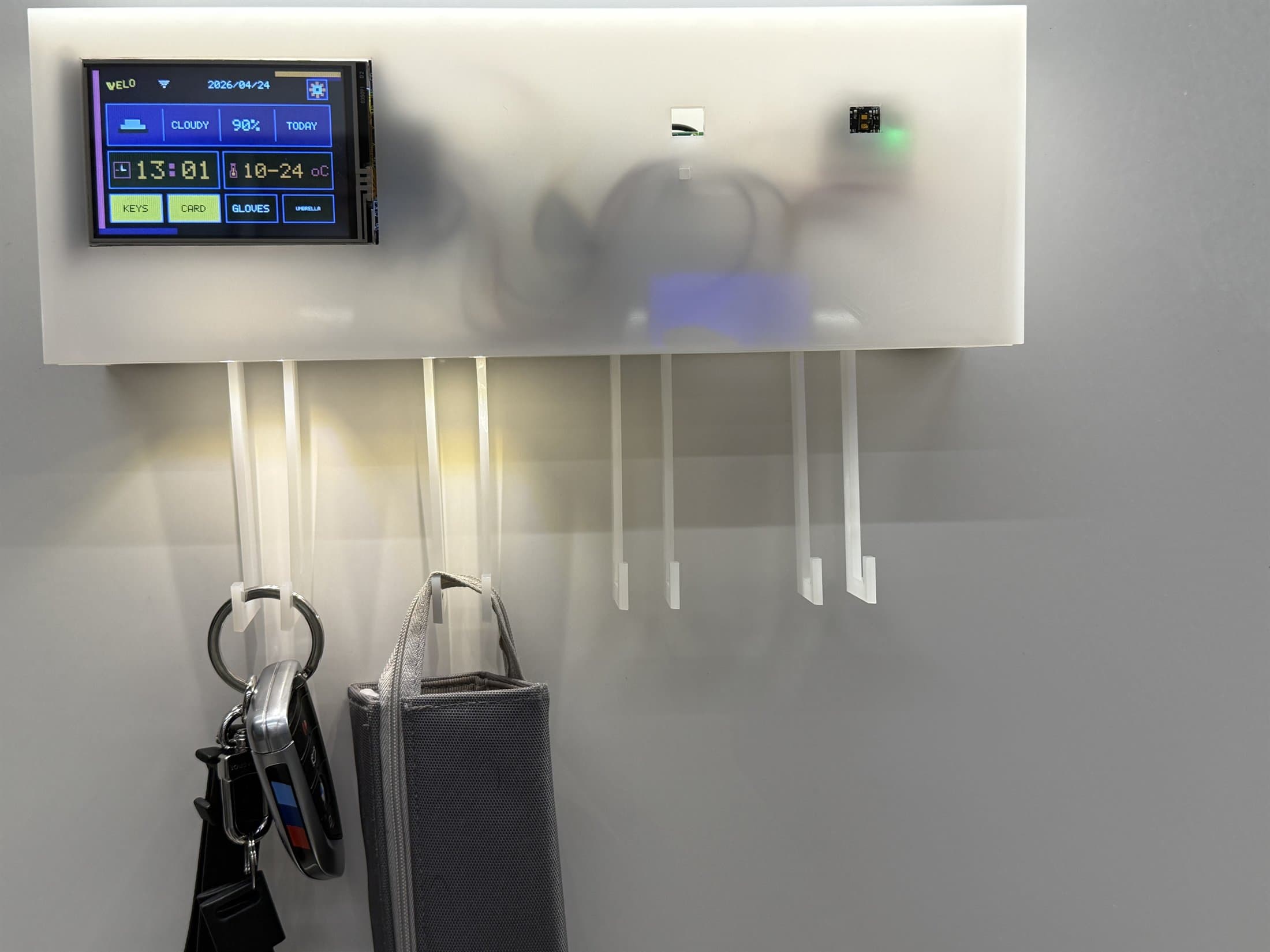
Product in context
A daily carry reminder surface: screen, hooks, and physical objects in one frame.
Velo shows time, weather, and reminder context where the user naturally checks before leaving.
A compact embedded screen exposes Wi-Fi, weather, brightness, OTA, and settings flows.
Physical hook lights map reminders from the interface into the environment.
Node-RED flows provide weather, release manifests, and validation endpoints.
Use case
The current prototype is deliberately focused: one installed surface, one room context, one daily moment, and enough reliability to feel like a product instead of a classroom demo.
Time, weather, and reminder state stay in the user’s natural doorway glance path.
Hook LEDs move the reminder out of the screen and into the physical object area.
OTA, fallback, and signed release policy protect the product behavior after deployment.
Vision
The next direction is not to make one heavier screen. It is to connect smaller, softer, BLE 5.0 and IoT-enabled home objects that can cooperate around the room.
Future Velo devices can become lightweight connected furniture accessories instead of isolated boards.
The next product is planned as a smart tracking camera that can coordinate with the Velo panel.
After the third product, the panel can become the central brain for a small smart-furniture ecosystem.
Next hardware revision
The first prototype proved the system. The next revision focuses on industrial design, touch quality, sensing integration, material choice, and power efficiency.
A larger display with a cleaner capacitive touch surface.
A lighter hook structure that keeps strength while reducing visual weight.
A more integrated enclosure using opaque, environmentally conscious materials, with only the rear cover remaining serviceable.
A more advanced low-power chip platform for better energy control.
A simplified sensing stack: remove ToF1, replace ToF2 with a compact infrared module integrated into the front panel.
Multiple visual editions instead of a box-like shape, starting with an antler-inspired version.
Next object
The second product is planned as a companion camera that can coordinate with Velo. The panel becomes the interface; the camera becomes the moving eye; together they hint at a future connected home system.